
Running Hermes Agent cheaply, from free to frontier
Pull-quote: “A model that is cheap per token and unreliable at tool calling is expensive per completed task, because every retry pays for the whole context again.”
Running Hermes Agent cheaply is mostly about context discipline, because the harness is free and every step of every loop re-sends your context to a model you pay for. Hermes Agent is an open-source, MIT-licensed agent harness from Nous Research that runs on your own machine, so there is no licence fee, no seat charge, and no usage meter inside the tool. Your spend is inference, priced per token in and per token out at whichever provider you point it at.
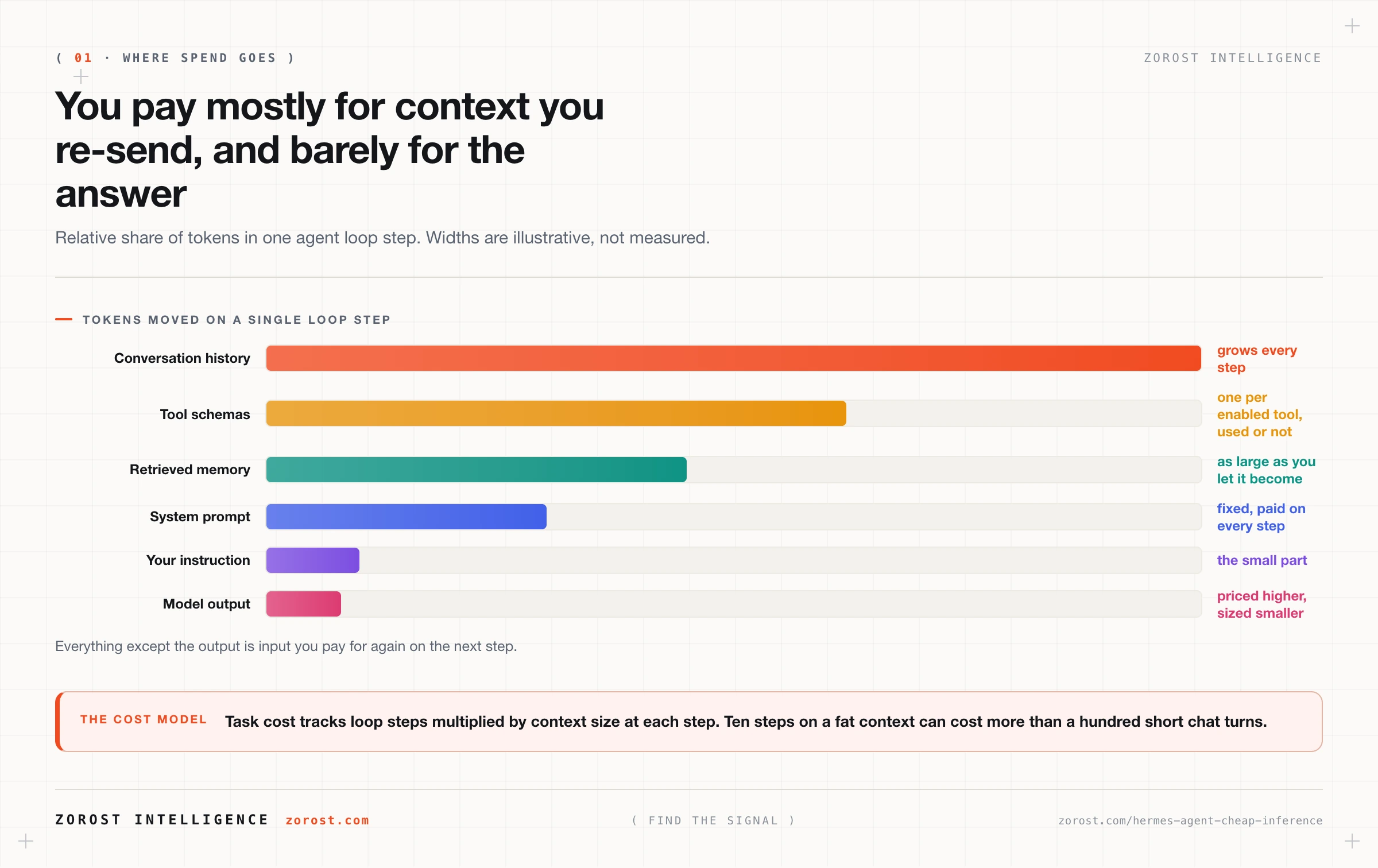
That one fact changes how you economise. A chatbot charges you roughly once per question. An agent works in a loop: it reads, decides, calls a tool, reads the result, decides again. Each pass sends the whole working context again, so an eight-step task pays for the system prompt, the tool schemas, the retrieved memory, and the conversation so far, eight separate times. Loop depth multiplied by context size is what shows up on the invoice.
This post assumes Hermes is installed and one provider works. Every quantity here is relative on purpose, since prices and rate limits change month to month and what lasts is the method.
What you will be able to do
- Explain where token spend goes inside an agent loop, and why loop depth matters more than how many requests you make.
- Configure an aggregator provider so you can compare models on your real workload without opening more accounts.
- Judge a cheap model on the four axes that decide whether it survives inside a harness, starting with the 64,000 token context floor.
- Cut spend with
/compress, leaner memory, and narrower tool sets, then escalate with/modelonly when a task earns it. - Recognise the three signals that mean your own hardware now costs less than per-token pricing.
What are you actually paying for when you run Hermes Agent?
You pay for inference, and for nothing else. The harness is MIT-licensed and self-hosted, it collects no telemetry and no usage analytics, and it is light enough to sit on a very small VPS because the expensive work happens at the provider. There is no tier to upgrade and no seat to buy.
Inside a single loop step, the request you send is mostly things you have sent before. The system prompt is fixed and paid for on every step. Tool schemas ride along for every tool you have enabled, whether or not the model uses them. Retrieved memory arrives according to what you have accumulated. Conversation history grows until you compress it or start a new session. Your actual instruction is usually the smallest part of the payload.
You can build your own cost model without any published price. Add up the prompt tokens at each step of one task you run often, where step five carries the fixed overhead plus everything from steps one through four, then multiply by your provider’s input rate. Most people run that arithmetic once and find that two or three scheduled jobs dominate, while interactive chats barely register.
Why start with OpenRouter instead of a direct provider account?
OpenRouter is the practical default when you are starting out, because one key gives you many models and switching between them costs a config change. Hermes supports more than 30 providers plus any OpenAI-compatible endpoint, and model identifiers are provider-prefixed, so you can name one at launch:
hermes chat --model openrouter/google/gemini-3-flash-previewKeys live in ~/.hermes/.env as ordinary environment variables, and hermes model browses and sets your default. For OpenRouter and Nous Portal the model list comes from a remote JSON manifest with a one-hour default TTL, falling back to an in-repo snapshot when you are offline, so the catalogue stays current without you editing anything. Set model_catalog.enabled: false in ~/.hermes/config.yaml if you would rather pin it.
The real argument for an aggregator is measurement. Commit to one key for a week of genuine work, then read your provider’s usage page. You will learn which habits are expensive before you sign up for anything long-lived or buy a graphics card. Choosing and configuring models for Hermes Agent covers the provider abstraction and the catalogue.
How do you pick a cheap model without breaking the agent?
Judge candidates on four axes in a fixed order: context window, tool-calling reliability, instruction following, and only then price. Reversing that order is the most common and most expensive mistake in self-hosted agent work.
| Axis | What to check | Why it decides your bill |
|---|---|---|
| Context window | At or above roughly 64,000 tokens | Below the floor, history is truncated and the agent redoes work you paid for |
| Tool-calling reliability | Valid tool calls consistently, including under long prompts | A malformed call means a retry, and a retry re-sends the entire context |
| Instruction following | Whether it honours format, scope, and stop conditions | Drift adds loop steps, and steps are where spend lives |
| Price per token | Compare only among models that passed the first three | Cheapest per token means nothing if the task needs three attempts |
Hermes needs a model with roughly 64,000 tokens of context or more to work well as a persistent agent, and it tells you what it found. On startup the CLI prints the detected limit, for example Context limit: 128000 tokens. That line is your checkpoint: if a model you just selected reports a number below the floor, pick another one before you debug anything else. One clarification while you are choosing, because the naming confuses people: Hermes Agent is a harness, separate from the Hermes family of language models that Nous Research also publishes, and it runs any supported model you point it at.
What makes cheap inference genuinely enough, and where is it a false economy?
Cheap inference is safe wherever a mistake is cheap to notice and cheap to undo. That test does more work than any benchmark you could look up. Summarising a document you will skim anyway, classifying and routing items, extracting fields from semi-structured text, drafting something you intend to edit, and routine file work inside one folder all pass it.
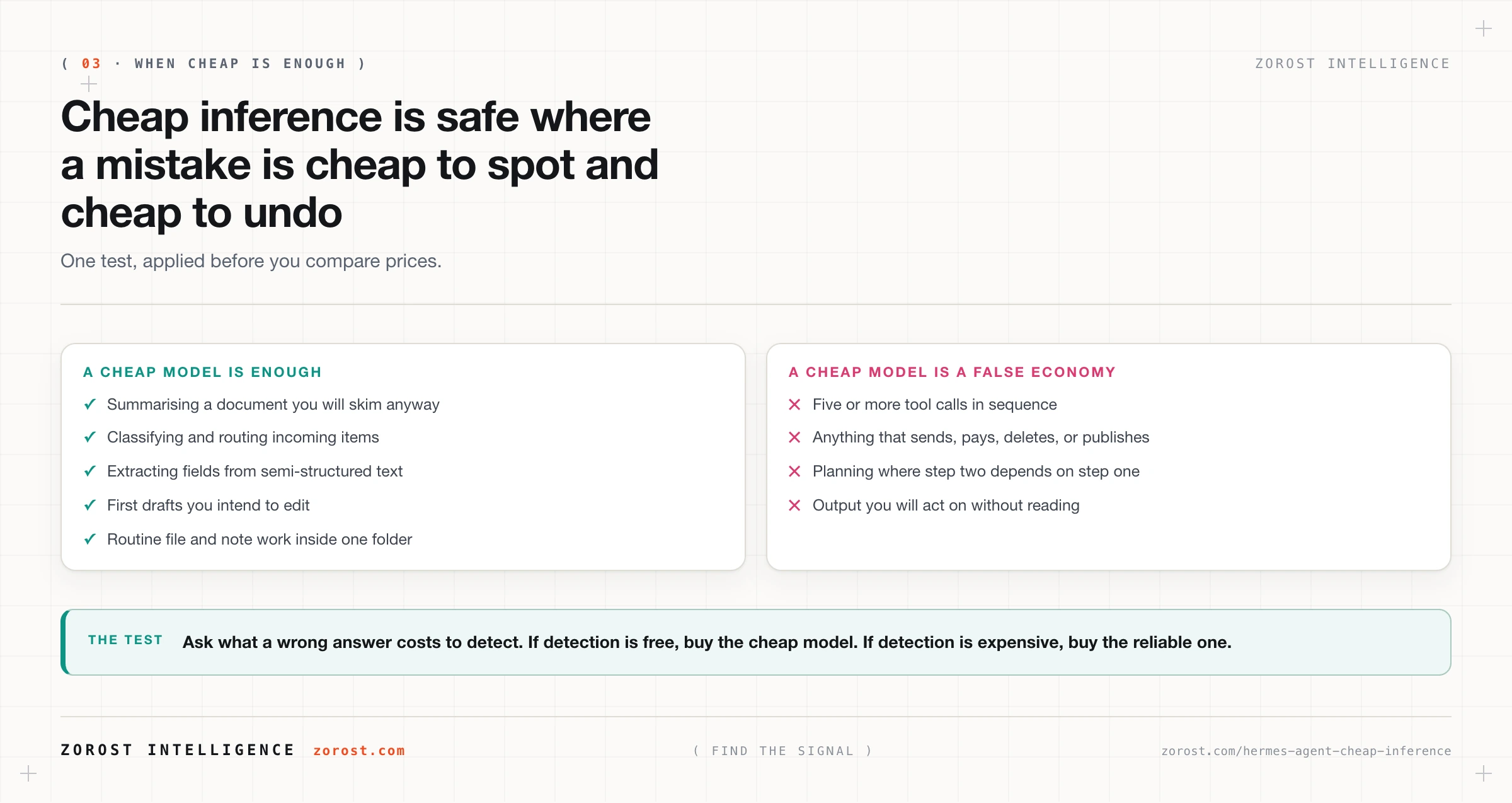
The false economies share a shape: the cost of a wrong answer gets paid somewhere you are not looking. Orchestrating five or more tool calls in sequence is one, because error compounds and each retry pays full context. Anything with an irreversible side effect is another: sending mail, writing to a repository, publishing, paying, deleting. Long-horizon planning is the third, since a wrong turn at step two invalidates steps three through nine and you find out at the end.
How does context discipline cut your bill more than model shopping?
Context discipline compounds across the loop, while a cheaper model is a one-off discount. Trim a thousand tokens from what every step carries and you save it on every step of every task from now on. Four levers do most of the work.
- Run
/compresswhen a session holds history you no longer need in full. It trades verbatim detail for room, which is the trade you want at a topic boundary. - Keep memory lean. Semantic memory is retrieved by relevance, so a bloated
memory.mdcosts tokens and crowds out the facts that matter. - Scope your tools. Every enabled tool ships its schema on every request, so narrow the allowlist in
~/.hermes/config.yamland turn off what you are not using this week. - Start a fresh session for unrelated work. Running one enormous thread across three projects is the most expensive habit available to you.
mcp_servers:
  filesystem:
    command: "npx"
    args: ["-y", "filesystem-mcp@latest", "--root", "/absolute/path/to/project"]
    tools:
      include: [read_file, write_file, list_directory]
      resources: false
      prompts: false
    enabled: true
That block does two jobs at once. Setting resources: false and prompts: false and listing three tools keeps the schema payload small, and rooting the server at one project keeps the blast radius small. Connecting MCP servers to Hermes Agent safely goes through the full configuration, and treating the context window as a budget covers the packing and eviction strategy behind all of this.
How do you mix model tiers without deciding every time?
Set a cheap default and escalate deliberately with /model. A default means routine work needs no decision from you, and /model means promoting a hard task costs one keystroke instead of a config edit and a restart.
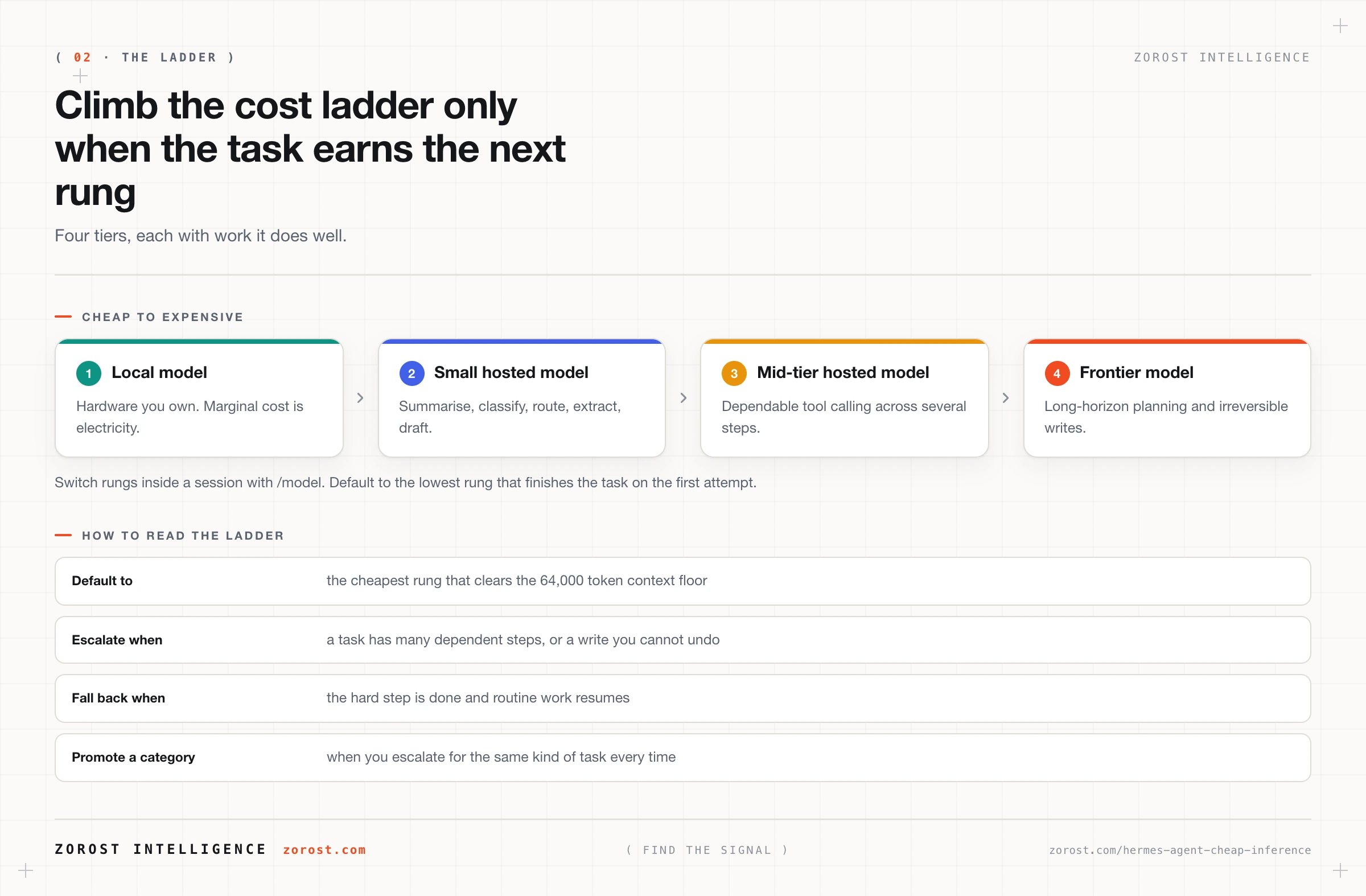
The rhythm is simple. Start on the cheapest rung that clears the context floor and calls tools reliably. When you hit many dependent steps, or a write you cannot undo, switch up for that stretch and back down afterwards. If you escalate for the same category of task every time, that category belongs on the higher tier by default.
When does your own hardware beat per-token pricing?
Hardware wins when your duty cycle is high, when your workload is routine, or when the data cannot leave your network. Per-token pricing has no idle cost, which is unbeatable while you are experimenting. Hardware inverts that shape: a fixed cost up front, then a marginal cost near zero, so the crossover moves toward hardware every hour your agent spends working.
Three signals tell you that you have crossed. Your scheduled jobs run all day and the interactive chats barely register. Most of the work is summarising, classifying, extracting, and filing, which a small local model handles acceptably. Or policy forbids sending the content out at all, in which case the economics never mattered. Running Hermes Agent fully local with vLLM, Ollama, and llama.cpp is the practical follow-through, including the part everyone underestimates, which is holding a 64,000 token context in your own memory.
What do a spend-nothing and a spend-a-little setup look like?
Both are real configurations that take about the same effort to wire up, and they differ in how much the agent can handle once it runs. Pick the first if a machine is sitting idle and you have patience for setup.
The spend-nothing recipe puts inference on hardware you already own:
- Serve a model locally with Ollama, which presents an OpenAI-compatible endpoint at
http://localhost:11434/v1. - Choose the smallest model that clears the 64,000 token context floor and calls tools without mangling arguments.
- Keep memory tight, enable a narrow tool set, and run
/compressat every topic boundary. - Accept the trade: weaker reasoning on hard tasks, and evenings spent on operations.
The spend-a-little recipe keeps inference hosted and controls the volume:
- One aggregator key in
~/.hermes/.env, with a small model set as your default throughhermes model. /modelescalation reserved for multi-step tool work and irreversible writes.- A spend limit configured at the provider, since that is the only cap that stops charges.
- A weekly look at your provider’s usage page, filtered to the days your scheduled jobs ran.
Some providers offer no-cost tiers, and Hermes supports OAuth providers such as Nous Portal and Qwen Portal whose refresh tokens land in ~/.hermes/auth.json. Free tier terms change without notice, so check the provider’s own page instead of trusting a blog post, including this one.
Where this goes wrong
Spend climbs while your usage feels flat. A rising bill with no new habits usually means one long-lived session whose history keeps growing, since every step re-sends all of it. Run /compress, or start a new session for each unit of work.
A model looks cheap per call and expensive per task. You see repeated attempts, malformed tool arguments, and the agent apologising and trying again. Weak tool-calling reliability turns one task into three, and each retry pays full context. Measure your cost per completed task, then move the tool-heavy steps up a tier.
The agent forgets mid-task right after you saved money. The cheaper model you switched to sits below the context floor, so history is being truncated and the agent no longer knows what it already did. Read the Context limit: line on startup and reject anything under roughly 64,000 tokens.
Every session drags along tools it never touches. Schemas for a dozen MCP tools ride on every request because every server is enabled globally. Set enabled: false on servers you are not using and tighten tools.include to the operations you call.
Scheduled jobs quietly become the largest line item. The gateway scheduler ticks every 60 seconds and runs whatever is due, whether or not anyone reads the output. Audit the job list, reduce frequency to what you act on, and narrow each prompt so a job does one thing.
Common questions
Does Hermes Agent itself cost anything?
No. Hermes Agent is open source under the MIT licence, runs on your own machine, and sends no telemetry or usage analytics anywhere. The only charges come from the model provider you configure, and a locally served model produces no invoice at all.
Is a local model really free?
The marginal cost of a token is electricity, which is close enough to free for personal use. You pay in other currencies: the hardware, the hours spent getting an engine and a model working, and the capability you give up against a frontier model. For high-volume routine work it is the correct choice.
Is an aggregator or a direct provider account cheaper?
It depends on your volume and which models you settle on, which is why measuring beats choosing. An aggregator wins early, since switching is free and you manage one key. A direct account can win once your usage concentrates on one or two models.
Will /compress lose something I need?
It trades verbatim detail for context room, so yes, some specifics get summarised away. Use it at a natural boundary, after a task is finished and verified, and avoid it mid-debugging where the exact error text still matters.
Can I set a hard spending cap?
Set it at the provider. Hermes bills nothing itself and cannot stop a charge your provider has already accepted, so provider-side spend limits are the only reliable ceiling. Narrower tool sets, shorter sessions, and fewer scheduled jobs slow the rate at which you approach it.
Does a larger context window cost more even if I do not fill it?
No. You pay for the tokens you send and receive, and the size of the window is free headroom. Filling that headroom with history is what costs you, so the discipline is to use the room deliberately.
Next steps
Read running Hermes Agent fully local with vLLM, Ollama, and llama.cpp next if the crossover signals here describe your workload, because it covers the part that decides whether local is viable: keeping a large context on hardware you own.
For the theory behind the routing ladder, including prompt caching, batching, and the true cost of retries across a whole system, see cost and latency engineering for LLM systems.
The same discipline, a cheap model by default with escalation only where a step is irreversible, runs behind FreightCortex in freight operations, where routine classification happens at volume and a wrong write costs a real shipment.