
River Strike: what a three-model relay ships when the brief is a finished game.
Can a cost-efficient implementation model, a frontier auditor, and an orchestrating model ship a complete browser game between them? We handed the relay one brief: an original vertical-scrolling river campaign, clean-room from the first commit, built to a sale-ready standard. This report records the division of labor, the audit trail, and the corrections only a human flagged.
The Finding
Lead with the answerThe relay ships, and the seams are where we expected people to matter. Across a phased window, the three models produced a complete, deterministic river campaign: about 12,900 lines of TypeScript in 97 files, 168 unit tests, procedural art and synthesized audio with no external asset files, and a 354 KiB gzip initial payload against a 950 KiB budget. The division of labor held: the cost-efficient model carried the bulk of implementation, the frontier auditor logged 29 findings in one deep review pass, 14 of them high severity, and every one was closed before the next phase. What no model flagged is the finding worth keeping: every game-feel correction in the record, gates spawning too close to the banks, an engine sound players muted, enemy silhouettes sinking into the water, a campaign that ended too soon, a fuel economy that quietly starved the tank, a phone build that needed real thumbs before its controls made sense, came from human playtests. The models built the game. The judgment that it felt wrong stayed ours.
The question
Can a phased relay of three models carry a complete game from empty folder to deployed build, and where does it still need people?
The subject
GLM-5.2, GPT 5.6 Sol, and Claude Fable 5 in a phased relay, with a human owner gate on every phase.
Not a claim about
Model rankings, other genres, or unsupervised autonomy. One game, one recorded window.
Under Test
Stack and environmentThe Account
How it was built and what happenedA finished game, not a demo.
The brief was deliberately commercial: an original vertical-scrolling river campaign in the lineage of the classic river shooters, built clean-room from the first commit, with original branding, original art, original audio, and a proprietary, sale-ready license. Demos forgive missing settings screens and placeholder sound. A finished game does not, which is why the brief was scoped as one: menus, settings, seeded missions, results, persistence, touch controls, and a deterministic campaign that adapts to how the player flies.
Two disciplines made the experiment measurable. Every phase ended at a gate: type checks, the full test suite, deployment budgets, and a text-hygiene scan that fails the build if restricted legacy terms appear anywhere in the tree. And every claim in this report traces to a logged phase record, a test, or a build output.
Three models, one baton.
The relay ran as a phase plan, not a free-for-all. A binding specification fixed the design before implementation began: terrain rules, entity behavior, scoring, fuel, state machine, audio design, and acceptance criteria per phase. GLM-5.2 implemented against that specification in bounded phases. GPT 5.6 Sol then audited the whole tree in one deep pass. Claude Fable 5 directed the relay, closed the findings, and carried polish and deployment.
Handoffs were written, not conversational: each phase ended with a build log entry recording what shipped, what the gates measured, and what the next model needed to know. The audit pass returned 29 findings, each with severity, file, line, and reproduction steps. Fourteen were high severity, including input-buffering and weapon-timing defects that play-testing alone would have taken far longer to isolate. All 29 were closed before the polish phase began.
- A binding specification and phase plan written before the first line of game code
- Automated gates on every phase: types, 168 tests, budgets, text hygiene
- One deep audit pass: 29 findings logged with severity and location, 29 closed
A complete game, measured.
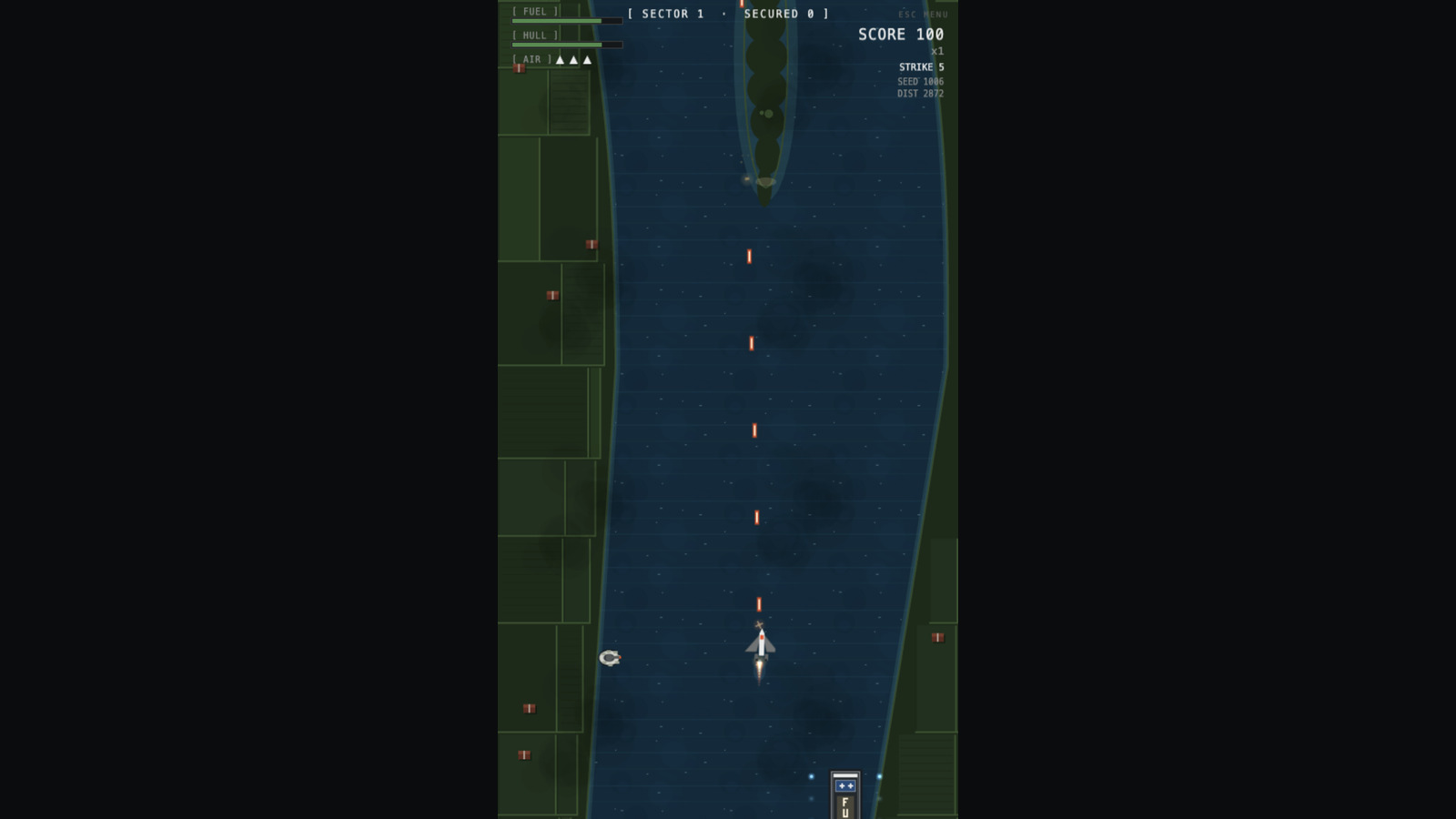
The measured output is about 12,900 lines of strict TypeScript across 97 files, 18 of them test suites holding 168 unit tests. The game is deterministic end to end: patrols derive from seeds, terrain generation is validated across 120 seeds in the test suite, and the corridor-width guarantee at every objective is swept across 60 seeds. Identical seeds replay identical patrols, which is what makes the campaign testable rather than anecdotal. Even the fuel economy is an asserted invariant: one depot pass at cruise must restore at least double the widest station gap, and a slowed pass must fill ninety percent of the tank.
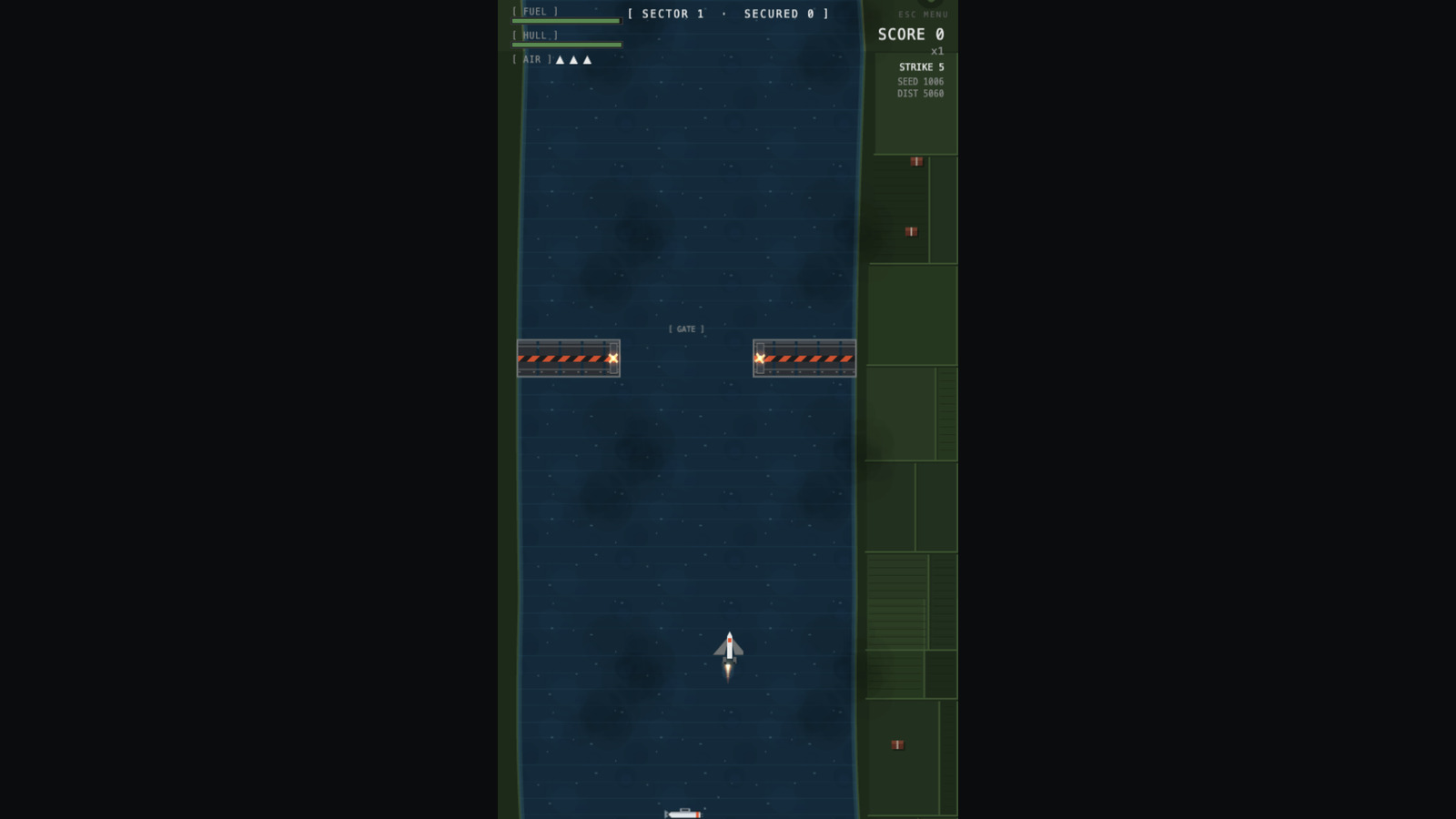
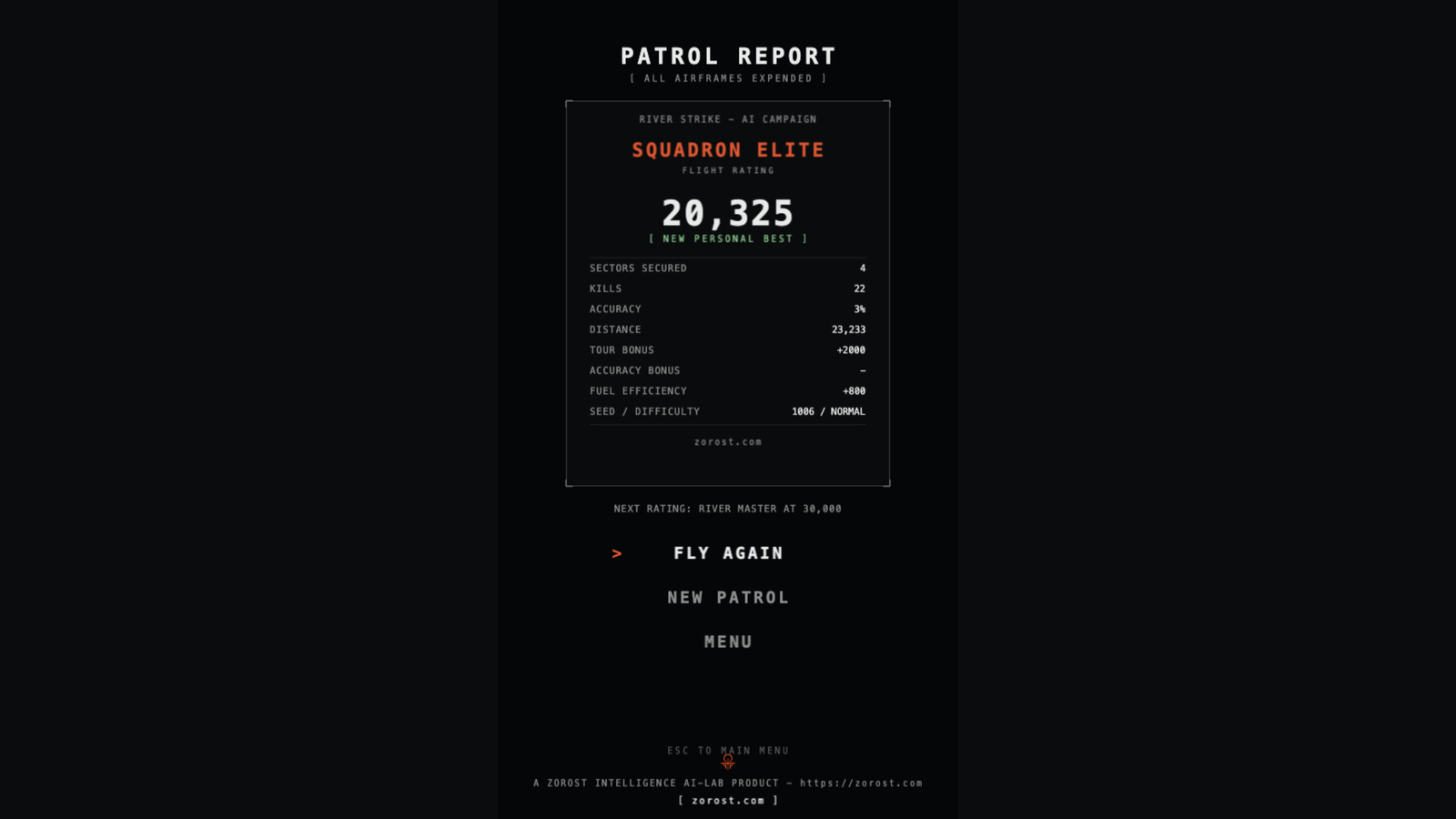
The patrol itself is endless by design: every sector ends at a fortified crossing, and the next runs narrower water, denser threats, and longer gaps between fuel stops, with mid-river islands forcing channel choices in the later sectors. A ladder of flight ratings, from River Qualified at 2,500 points to Zorost Ace at 60,000, turns the score into something worth a screenshot, and every run ends on a framed patrol report built to be shared.
Everything on screen and in the ear is procedural. Five enemy classes, five selectable airframes, terrain, and interface elements are drawn in code at load; the engine wash, cannon, explosions, and a signature melodic motif are synthesized through Web Audio at runtime. The audio system is mixed on four player-controlled buses tuned against auditory-fatigue research, with an optional calm layer for long sessions. The build ships no art or audio files beyond the Zorost mark, which is why the initial payload holds at 354 KiB gzip against a 950 KiB budget, most of it the Phaser runtime itself.
The models never said it felt wrong.
Nine material corrections in the record came from human playtests, and none of them were caught by any model in the relay. Crossing gates could spawn so close to the banks that they were unhittable on narrow water. The engine tone was a buzz players would mute, and the cannon sound was worse. Enemy silhouettes merged into the river at speed. The respawn after a lost aircraft was abrupt enough to feel unfair. A settings screen silently overrode a player choice on every boot. The campaign ended after a fixed number of crossings when it should have run as long as the pilot could fly. The countdown before launch read as a toy, not an operations room. And the first phone session found a letterboxed canvas, buttons too small for thumbs, silent audio on iOS, and a back control that only worked with a keyboard nobody had. Each fix was mechanical once named: the terrain generator now widens the river around every objective, the audio system was rebuilt on four buses against auditory-fatigue research, the enemy set was redrawn against a size ladder in the classic style, the mission became an endless patrol with a rating ladder, the countdown became a pre-flight checklist, and the phone build got a full-bleed canvas, one-thumb steering with drag throttle and autofire, opt-in tilt control, a tappable pause menu, and an iOS audio path that survives the silent switch. Naming them took a person playing the game.
The other human layer was rights. The brief asked for real military aircraft names in the hangar; a review of trademark exposure replaced them with an original Zorost designation series, and the decision record travels with the project. The relay also holds a standing quarantine of legacy-game source material that predates this project, enforced by the same build gate that scans for restricted text. Models applied these policies. People set them.
An homage in genre, original in every asset.
River Strike honors a genre that is over forty years old: fly up the river, manage fuel, clear the crossings. The homage ends at the genre. Every line of code, every sprite, every sound, and every name in this build is original work produced in the recorded window, and the build gate fails on any restricted legacy term as a standing check. The game ships under a proprietary license because the brief was a sale-ready product, so this experiment publishes its evidence pack, this report, the measurements, and the live build, rather than the source tree.
From the Field
Captured from the live build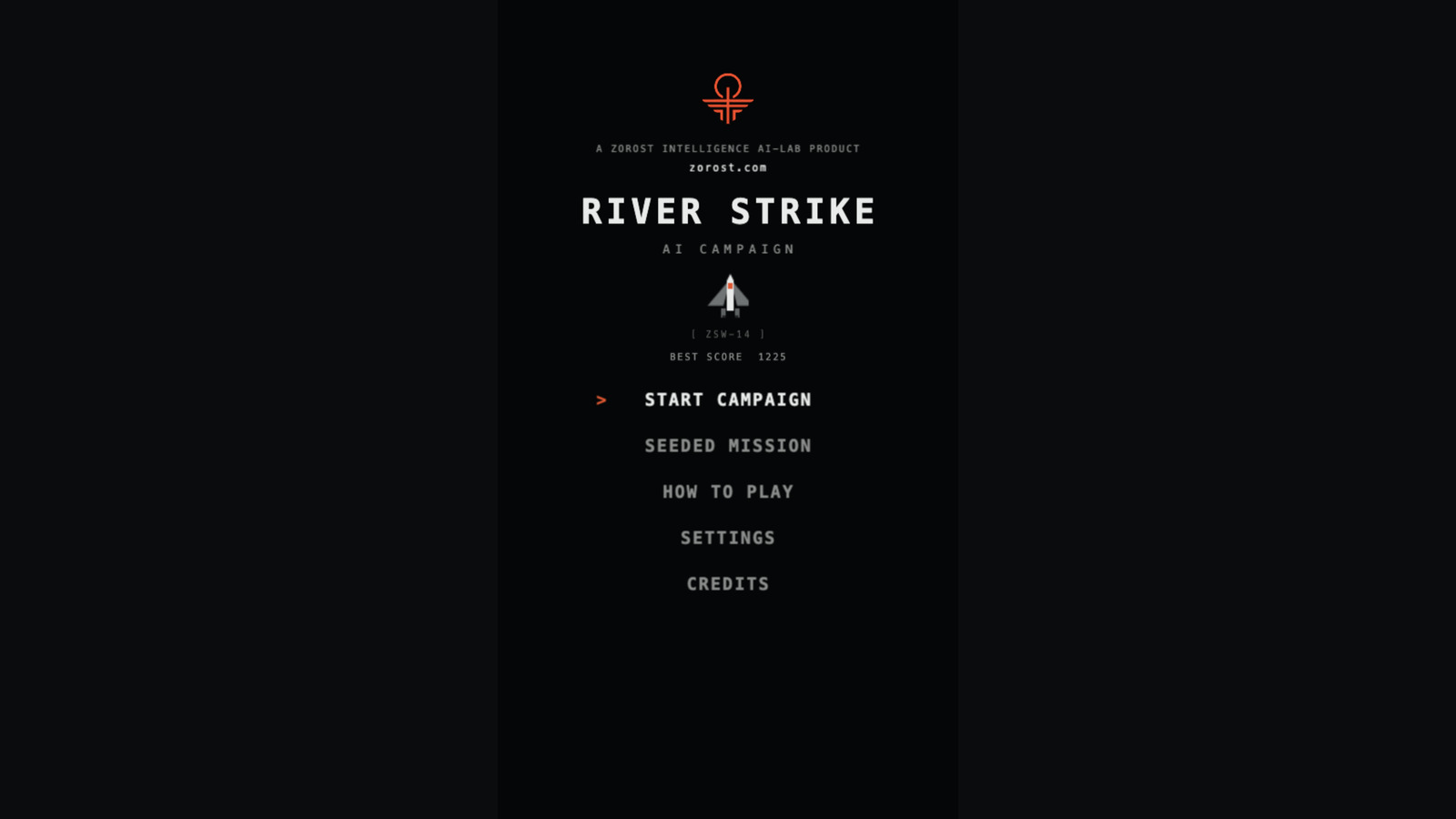
What Held, What We Flag
Wins and limits, side by side- The full game loop shipped: an endless campaign, seeded missions, a full sound mixer, shareable patrol reports signed with a pilot callsign, persistence, and first-class mobile controls (one-thumb touch, drag throttle, opt-in tilt), all live in the deployed build.
- Determinism held under test: 120-seed terrain validation, a 60-seed corridor-width sweep at objectives, and identical replays from identical seeds.
- The phase-gate discipline held: 168 tests green through every handoff, and no phase advanced over a failing gate.
- The audit pass earned its place: 29 findings with reproductions, including high-severity input and weapon-timing defects, all closed.
- Budgets held with room: 354 KiB gzip initial payload against a 950 KiB ceiling, with no external art or audio files.
- Game feel stayed human. Every correction about how the game feels, gates, audio, silhouettes, pacing, came from human playtests, not from any model in the relay.
- The audit found defects, not taste. The deep review caught what was incorrect, and said nothing about what was unpleasant.
- Rights judgment stayed human: trademark exposure on aircraft names and the decision not to imply any legacy-publisher affiliation were people calls.
- The source is not public. The game is a proprietary, sale-ready build, so readers get the evidence pack and the live experiment, not a tree to re-run.
- One game, one window. This is a dated field record of one relay on one genre, not a ranking and not a general claim about any model.
Measurements
Enforced on every build- Models in the relay
- GLM-5.2 · GPT 5.6 Sol · Claude Fable 5
- Build window
- Phased relay, July 2026
- TypeScript produced
- About 12,900 lines, 97 files
- Unit tests
- 168 across 18 suites, green at every gate
- Audit findings closed
- 29 of 29, 14 high severity
- Initial HTML, CSS, JS (gzip)
- 354 KiB against a 950 KiB budget
- External asset files shipped
- 1, the Zorost mark
Three models carried the build. The taste stayed human.
Disclosures
What a careful reader deserves- Model output entered the build only after the phase gates and a human owner review. No unreviewed generated code ships in this experiment.
- The game runs entirely in the browser. Settings, scores, and progress persist in local storage on the player's device. The build collects no personal data.
- This is original work: no code, art, audio, or names from any prior title, enforced in part by a build gate that fails on restricted legacy terms.
- The genre homage is acknowledged by design. No affiliation with, or endorsement by, any legacy publisher is implied.
- The build is proprietary and sale-ready by brief, so the source tree is not public. This report and the live experiment are the published evidence.
- Vendors and models are named as test subjects only. This is a dated field record, not an endorsement and not a product claim.
Go Deeper
Run it · read it · build on itServing those who
need to stay ahead.
We don't pitch slide decks. We show you what we've already built in your domain, then engineer what your mission requires.