
Generative Flow Engine: field equations you can touch.
Can a team of assigned AI agents turn textbook physics and classical mathematics into a public instrument a visitor can touch? We split the work the way a lab splits it: agents to plan the architecture, agents to build the physics, an adversarial agent to audit every line of the result, and a verification rig to capture the evidence. This report records what the team produced, what the auditor caught that no eye could, and where this pattern is already heading in research visualization and simulation.
The Finding
Lead with the answerA team of agents can carry the whole instrument, and the separation of roles is where the trust comes from. Across a recorded July 2026 window, the assigned agents produced a complete browser laboratory: about 7,500 lines of dependency-free JavaScript and GLSL across 31 modules, a spring-lattice particle system that holds up to half a million particles, twenty-five named vector fields, from curl noise to the double-gyre ocean benchmark and the Kármán vortex street, plus a custom field composer, a procedural gallery of 101 figures spanning five collections, mathematics, sacred geometry, woven patterns, nature studies, and historical ornament, a separate collection of 28 extracted Imperial vectors, and the flags of all 197 sovereign states rendered in their own colors. The initial payload remains about 56 KiB gzip because the browser fetches each vector only when selected. The decisive role was not the builders but the auditor. Assigned to read the finished source line by line with no attachment to the code, it logged 21 findings, three of them critical: a gesture guard that compared a point against itself and so could never reject anything, an imported graphic that silently included its invisible scaffolding, and a rendering context that never recovered once the GPU took it away. The subtlest finding was mathematical: the noise table behind the flow fields selected its gradients with a statistical bias, tilting every field toward its diagonals, invisible on screen and caught only in the arithmetic. Every finding was closed, and the fix pass surfaced one more. That is the result in one line: assign builders and you get an instrument in hours; assign an adversary beside them, and a human to judge what matters, and you get an instrument you can trust.
The question
Can a team of assigned agents with separated roles carry a physics and mathematics visualization from raw equations to a deployed public instrument, and where does the trust in the result actually come from?
The subject
Multiple assigned agents with separated roles: architecture and building, an adversarial line-by-line audit, and evidence verification, directed by a human owner who reviewed every output.
Not a claim about
Any specific model or vendor, numerical research computing, or unsupervised autonomy. One instrument, one recorded window.
Under Test
Stack and environmentThe Account
How it was built and what happenedAn instrument, not a demo.
The brief was a physics brief, not a software brief: take the systems that fill the first year of a mechanics course and make them run live where anyone can reach them. Springs obeying their restoring law with damping. Vector fields a particle can ride, including the curl construction that stirs a medium without compressing or dispersing it, the same mathematical device fluid simulation relies on. A magnetic dipole, a two-charge electrostatic field, three orbiting gravity wells, a standing wave on a membrane, and a slice of the Lorenz system. Beside the physics, a mathematical gallery: phyllotaxis at the golden angle, the Fibonacci spiral drawn through its golden rectangles, Lissajous figures, harmonographs with decaying amplitude, rose curves, epitrochoids, a torus knot, the Sierpinski triangle, the dragon and Hilbert curves, and the Euler spiral that railway engineers use to ease a train into a bend. The gallery has since grown to 101 figures across five collections, adding sacred geometry from the vesica piscis to the Sri Yantra, twenty woven carpet patterns, nature studies from the Barnsley fern to a peacock feather, and twenty patterns from the historical ornament canon, each generated at load from its equation rather than traced from a stored picture. A separate Imperial collection carries 28 optimized vectors adapted from supplied historical reference sheets; the report counts those assets separately from the generated figures.
The constraint that made it an experiment: everything had to hold up in an ordinary browser tab, at up to half a million particles, without installing anything, and without a single runtime dependency. And instead of handing the whole brief to one system, we assigned it to a team of agents with separated roles, the way a lab separates them. The human owner set scope, reviewed output, and decided what the instrument was for.
Separated roles, the way a lab separates them.
The team was assigned, not improvised. Architect and builder agents planned the module layout and then constructed the instrument: the spring-lattice physics core, the rendering pipeline with its trails and bloom, the control room, the synthesized audio. Each pass produced something a person could inspect: a running field, a measurable frame rate, a curve that either matched its textbook shape or did not. That inspectability matters, because the failure modes live in the artifact itself rather than in prose.
The role that mattered most was assigned last. An adversarial audit agent read the finished source line by line against a written checklist, with no attachment to the code it was reading, the way a careful referee reads a submission. Twenty-one findings came back, from three critical defects to dead code. Each was fixed, the build was re-verified, and the fix pass itself surfaced a twenty-second: a control that read its value but never wrote it back into the configuration. A verification rig then captured every image in this report from the running build. This division of labor is not our invention. It is the pattern the field keeps converging on, because the reliability of agent-built scientific code comes less from more capable builders than from structured checker roles that catch what builders cannot see in their own work.
- Architect and builder agents: module layout, physics core, rendering, controls, audio
- Adversarial audit agent: line-by-line review, 21 findings logged with file and line references
- Verification rig: every image in this report captured from the live build, re-capturable by anyone
- Human owner: scope, review gates, and the judgment calls between every pass
What the equations do when you can touch them.
Every particle in the instrument sits on a spring anchored to its home on the artwork, so the sculpture is a lattice in tension: push it and it hums back. The flow fields ride on top. The curl field deserves its own sentence, because it is the reason the motion looks like weather instead of static: taking the curl of a smooth noise field yields a velocity field with zero divergence, which means the particle medium swirls indefinitely without piling up or thinning out. The dipole field bends particles along magnetic field lines. The three-body field lets them fall around orbiting attractors. The standing wave makes the membrane breathe at its nodes.
This is where the usefulness argument stops being abstract. A reader can be told that a divergence-free field conserves density, or a reader can drag a pointer through one and watch the medium refuse to clump. An instructor can put the golden angle on a slide, or hand a student a slider and let phyllotaxis assemble itself from the rule. The instrument compresses the distance between an equation and an intuition, and the agent team compressed the distance between the equation and the instrument: hours of supervised sessions rather than a semester of engineering.
One instrument per idea, not one figure per paper.
The near-term value is in how quantitative ideas travel. Most physics and mathematics still moves as static figures: a vector field as a page of frozen arrows, phyllotaxis as a photograph of a sunflower, a resonance as a plot. An assigned agent team changes the economics of that. When an interactive instrument costs hours instead of a semester of engineering, it becomes reasonable to build one per idea: a field the reader stirs instead of a diagram the reader decodes, a golden angle the student perturbs and watches fail, a Lissajous ratio a slider sweeps through its whole family. The same team structure extends to teaching artifacts generally, where the builder produces the lesson's working model and the checker role verifies that what it teaches is actually true.
For mathematics specifically, the pattern favors exploration over certification. An agent team can generate an interactive family of curves or fields faster than a person can plot one, and walking a parameter space by hand is historically how conjectures get noticed. What the team does not do is certify meaning. The auditor role catches wrong arithmetic, as it did here; deciding what a pattern signifies, and what is worth the labor of proof, stays with the mathematician.
The toy version of a serious workflow.
This instrument is deliberately the toy version of a serious pipeline. The divergence-free curl field at its center is the same mathematical device production fluid solvers rely on, and the workflow that produced it, builders assigned to construction with an adversary assigned to review, is the same shape now being applied to real simulation work: agent teams that carry a problem statement to a configured run, boundary conditions and solver settings included, execute it, and post-process the results, with validator roles checking every configuration before expensive compute is spent. The connective work around a simulation, setup, translation, execution, verification, and presentation, is exactly the work a role-separated team does well.
The honest boundary in the field matches the honest boundary in this experiment. Choosing the model, judging whether a result is physical, and deciding which question deserves the compute remain human work. Our auditor found the biased noise table; it took a human to decide that a quietly wrong field, invisible on screen, was a deployment blocker rather than a footnote. Scale that lesson up and it reads the same: agent teams make simulation cheaper to reach and harder to silently get wrong, provided the adversarial role is staffed and a person owns the judgment.
The auditor caught what the eye cannot. The judgment stayed ours.
The most instructive defect in the record was invisible. The noise table that drives every flow field selected its gradient directions through a modulo operation that favored some directions over others, a statistical bias that tilted the entire field toward its diagonals. No screenshot shows it. No casual session feels it. It fell only to the audit, and it is exactly the class of defect that matters in research settings: a plausible field that is quietly the wrong field. The other critical findings were of a more familiar kind: a gesture check comparing a coordinate against itself, so every touch registered as a click; imported artwork silently including its invisible scaffolding as geometry; a rendering context that stayed dead after the GPU reclaimed it.
The judgment layer stayed human throughout. Which findings blocked deployment, what the instrument is for, what it must not claim to be, and the decision to publish the defect list beside the successes: those were owner calls. And the instrument itself is honest about its scale. Fields follow their stated equations, but the integration is first order and the coefficients are tuned for legibility on a screen, not for quantitative prediction. It builds intuition; it does not replace a solver. The build honors reduced-motion preferences, pauses itself in background tabs, degrades gracefully on slower machines, and runs entirely on the visitor's device, collecting nothing.
Read it, run it, take it apart.
Everything in this report is open. The full engine, the 101 generated figures, the flag collection, the extraction pipeline, and the unedited adversarial audit log are published under Apache-2.0 on GitHub. The country flags come from the MIT-licensed flag-icons set; the Imperial and traced-emblem vectors are sealed behind a passphrase because they derive from reference sheets licensed to Zorost, but the extraction geometry is published so the work is documented. A fresh clone runs the equation gallery and every flag with no key at all.
From the Field
Captured from the live build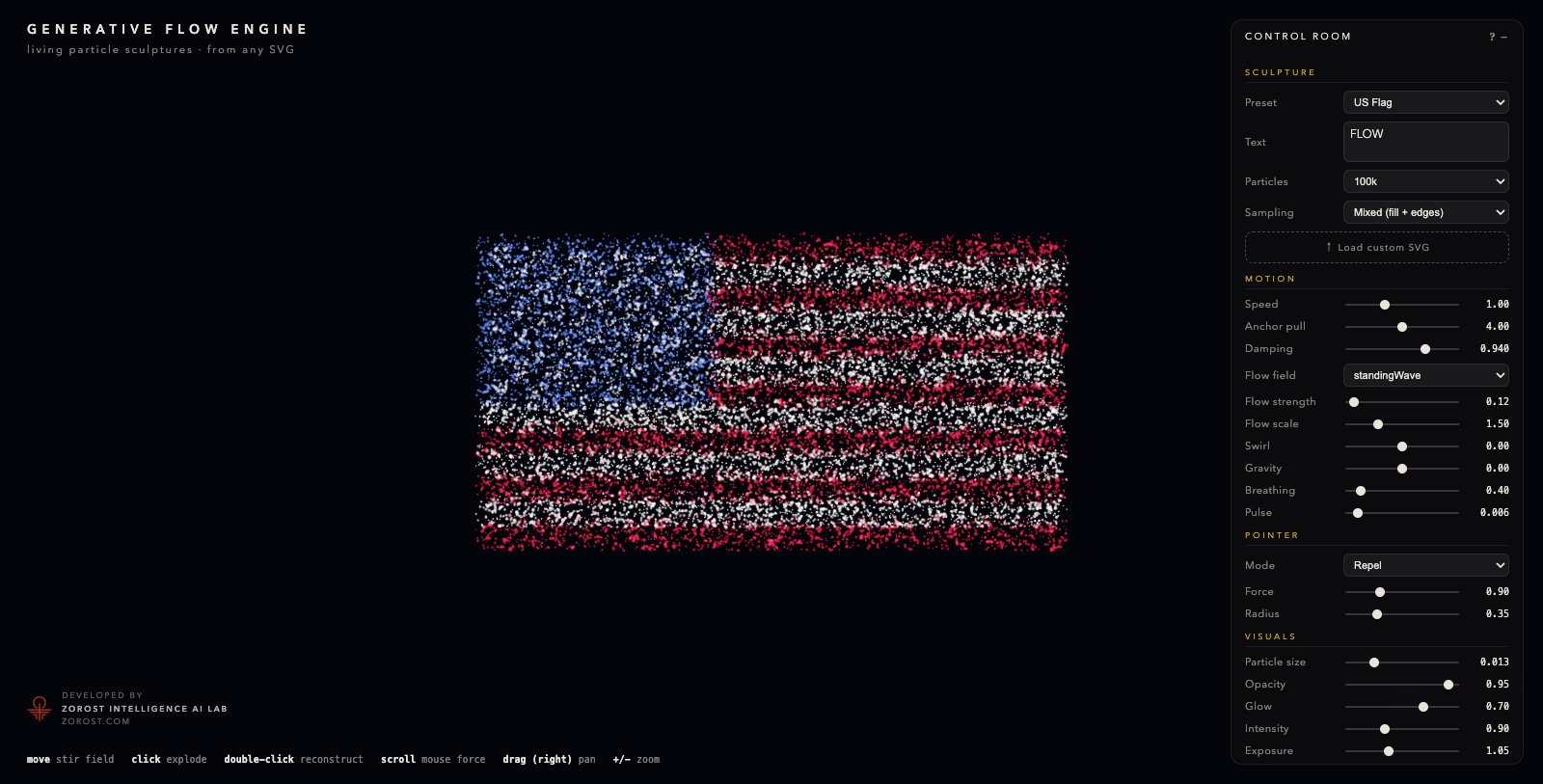
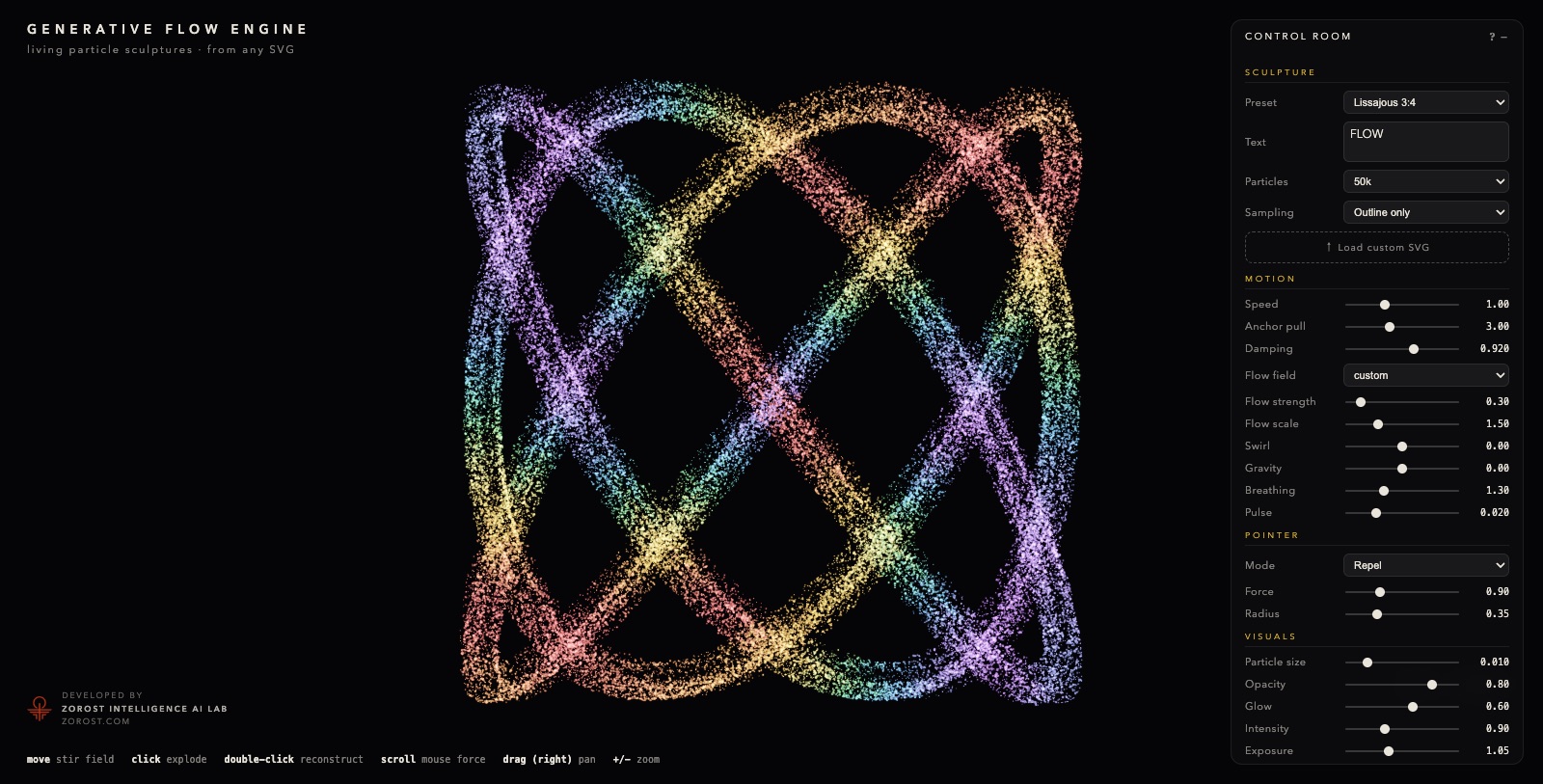
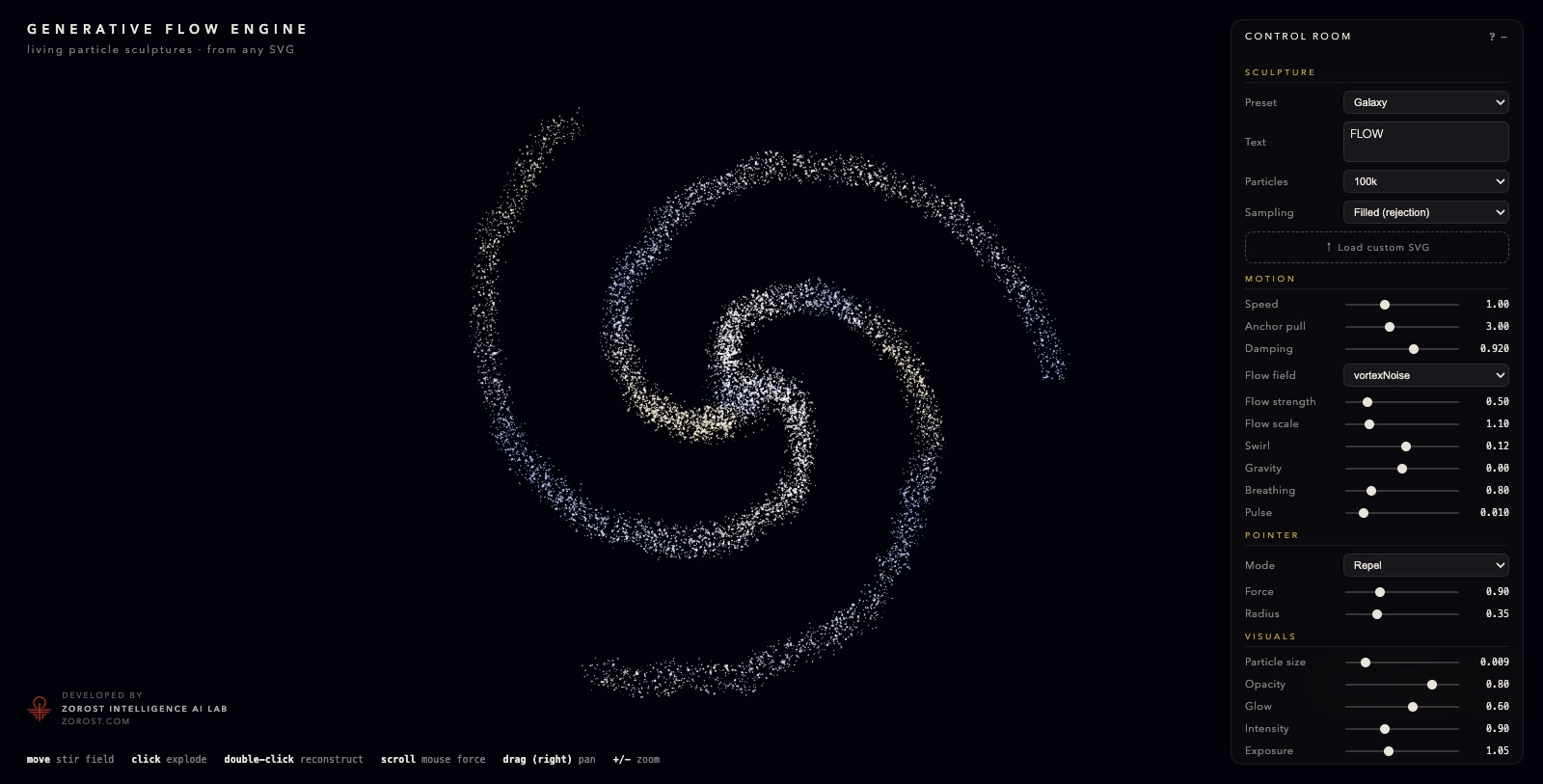
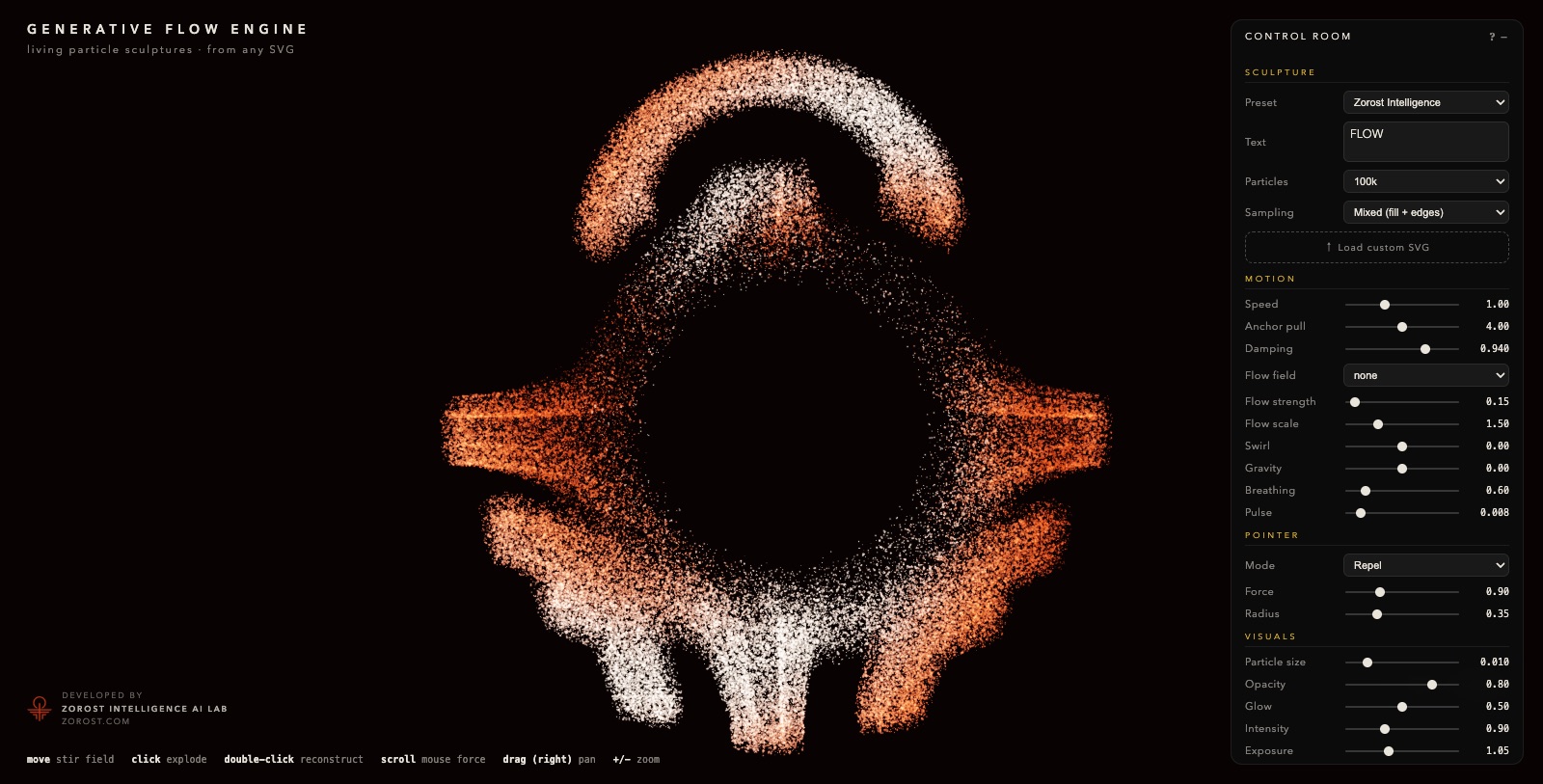
What Held, What We Flag
Wins and limits, side by side- The physics reads true: the curl field stirs the medium without piling it up, the spring lattice holds every form under interaction, and each of the 101 gallery figures is generated live from its equation.
- The instrument is light: about 56 KiB gzip initial payload with zero runtime dependencies, and the physics loop allocates nothing per frame at 100,000 particles.
- Degradation is engineered: a frame-rate governor raises draw stride before dropping frames, WebGL2 falls back to Canvas2D, and a lost GPU context restores itself in place.
- The audit loop closed: all 22 logged findings were fixed, including three critical defects, with the build verified green after every pass.
- Accessibility survived the physics: reduced motion holds the field still at load, every control carries a real label, and touch gets pinch zoom and two-finger pan.
- The instrument visualizes; it does not measure. First-order integration and legibility-tuned coefficients make it an intuition device, not a research solver.
- No builder flagged its own bias: the gradient defect in the noise table passed every visual inspection and fell only to the assigned adversarial audit. Builders alone would have shipped a quietly wrong field.
- Judgment stayed human. Scope, deployment gates, and what the instrument may claim were owner decisions the agents never attempted to make.
- One build, one window. This is a dated field record, not a claim that another brief, or another team of agents, would produce the same trail.
Measurements
Enforced on every build- Agent roles assigned
- Architecture and build · adversarial audit · verification
- Build shape
- About 7,500 lines, 31 modules, zero runtime dependencies
- Initial payload (gzip)
- About 56 KiB
- Particle capacity
- Up to 500,000; 60 fps target at 100,000
- Fields and curves
- 25 named vector fields plus a composer · 101 procedural figures
- On-demand vectors
- 28 Imperial symbols · 197 sovereign state flags
- Audit findings closed
- 22 of 22, 3 critical
- Build window
- Supervised sessions, July 2026
The agents wrote the field equations. The questions stayed human.
Disclosures
What a careful reader deserves- All instrument code was written by the assigned agents and entered the build only after the adversarial audit and a human review gate. No unreviewed generated code ships in this experiment.
- This report intentionally names no vendors or models. The build was carried by a team of assigned agents under human direction, and their identities are recorded in the internal session log.
- The experiment runs entirely in the visitor's browser and collects no personal data. Optional soundscapes are synthesized locally and are off by default.
- The physics is real in form and tuned in scale: fields follow their stated equations with coefficients chosen for legibility, not for quantitative prediction.
- The mathematical gallery is generated from public, classical equations. The flag collection uses the MIT-licensed flag-icons set, and the Imperial collection carries vectors adapted from licensed historical reference sheets. All assets ship locally with no remote dependency.
- The source is public under Apache-2.0 at github.com/zorost/generative-flow-engine, including the unedited adversarial audit log. The reference sheets behind the Imperial adaptations are licensed to Zorost and are not redistributed; the extraction geometry is published so the work is documented.
- This is a dated field record, not a product claim and not a general claim about agentic AI capability.
Go Deeper
Run it · read it · build on itServing those who
need to stay ahead.
We don't pitch slide decks. We show you what we've already built in your domain, then engineer what your mission requires.