
Defy the Vector: what a frontier code model builds when the brief is a planet.
How much production engineering can a frontier code model carry under direction? We gave GPT 5.6 Sol a one-page brief: first-person flight from a Washington garden to an orbital view of Earth, on real geography, inside enforced budgets. This report records what the model produced, how fast, what held, and where it needed us.
The Finding
Lead with the answerMore than we expected, and less than the demo suggests. Directed in supervised sessions, GPT 5.6 Sol produced roughly 3,500 lines of working TypeScript in a single overnight build window: a two-scene WebGL architecture that carries a viewer from a Washington sidewalk to low orbit with no loading wall, holds its 240 KiB initial payload budget with room to spare, and travels between real coordinates on correct great-circle arcs. The record is equally clear about where the model stopped being enough. It shipped asset paths that failed under a nested deployment, it could not judge texture redistribution rights, and its first attribution layer was silently stripped by the minifier. Human review caught all of it, which is the finding in one line: the model supplies speed and structure, and the discipline still has to be ours.
The question
How much of a budget-gated, production-grade WebGL experience can a frontier code model build under direction?
The subject
GPT 5.6 Sol in supervised sessions, with a human review gate on every output.
Not a claim about
Model rankings, other domains, or unsupervised autonomy. One experiment, one recorded window.
Under Test
Stack and environmentThe Account
How it was built and what happenedA hard prompt, on purpose.
The brief handed to the model was one page: build body-free first-person flight that starts at eye level in a Washington garden, crosses the atmosphere in one continuous move, and arrives at a navigable Earth, on real geography, with no avatar and no loading wall. City demos rarely leave the city and globe demos rarely start at human scale, so the seam between the two scales is exactly where generated code tends to fall apart. That is why it was chosen.
Two constraints made the brief measurable rather than impressionistic. Every build had to pass an automated budget gate, and every claim in the eventual report had to trace to something in the recorded sessions. The experience is the instrument. The model is the subject.
Direction, not delegation.
The first prompt was written on a Friday evening in July 2026. A budget-gated production build existed before morning. The sessions ran as supervised direction: bounded prompts, one decision at a time, and a human engineering review gate on every output before it entered the tree. Nothing merged on trust.
Inside that loop, GPT 5.6 Sol carried the implementation. It proposed the state machine that separates the ground field, the ascent, and the orbital field, wrote the movement model with inertia and altitude-scaled speed, and kept a single coherent architecture across the whole window instead of drifting into patchwork.
- Supervised sessions with bounded prompts and recorded decisions
- A human review gate on every output before it entered the build
- An automated budget gate failing any build that overran its limits
Structure first, then speed.
The measured output is roughly 3,500 lines of TypeScript across eighteen modules, about 5,600 lines of source overall once the page shell, styles, and build tooling are counted. The architecture is genuinely good: the planet, its imagery, and country boundaries load only when a viewer chooses to ascend, so a visitor who stays in the Washington field never downloads the Earth. That single decision, which emerged early in the sessions, is why the first payload sits at 179 KiB gzip against a 240 KiB budget.
The mathematics held up under re-testing. Orbital travel interpolates along the shortest spherical arc between real coordinates, distances derive from angular separation, and re-entry returns the viewer to the same Washington field they left. Speed and volume are not the story. Structure under constraint is.
The gaps were judgment, not syntax.
Four material corrections were logged in the window, and none of them were syntax. The model shipped relative asset paths that failed once the experiment was deployed under a nested route it had not been told about. It could not judge which Earth textures carried confirmed redistribution rights, a call that decides what may legally enter a public repository. Its first attribution layer was silently stripped by the minifier chain and had to be rebuilt in depth. And one deployed copy went out without its texture set until inspection caught the gap.
Every one of those corrections is a judgment call about context the model did not hold: deployment topology, intellectual property, provenance, and verification. That boundary, not code volume, is what this experiment was designed to locate.
Grounded, not survey-grade.
The Washington environment is geographically grounded but deliberately lightweight, built from bounded civic geometry with a few procedural landmark forms for orientation. It is not a survey, a navigation aid, or a claim about any specific structure. Treating a legible model as an authoritative one is exactly the mistake this program exists to avoid, so the interface and this report both name the boundary.
From the Field
Captured from the live build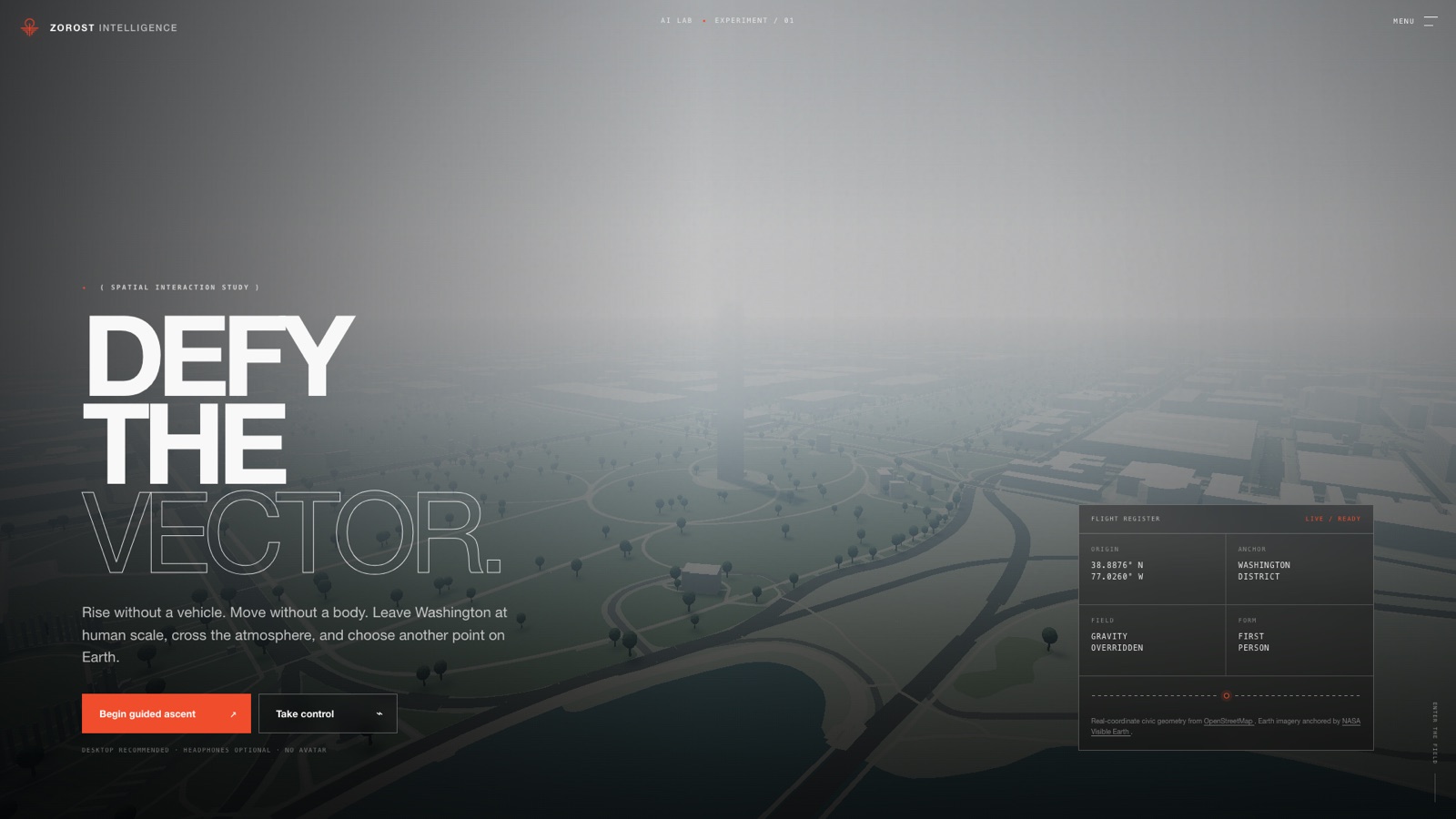
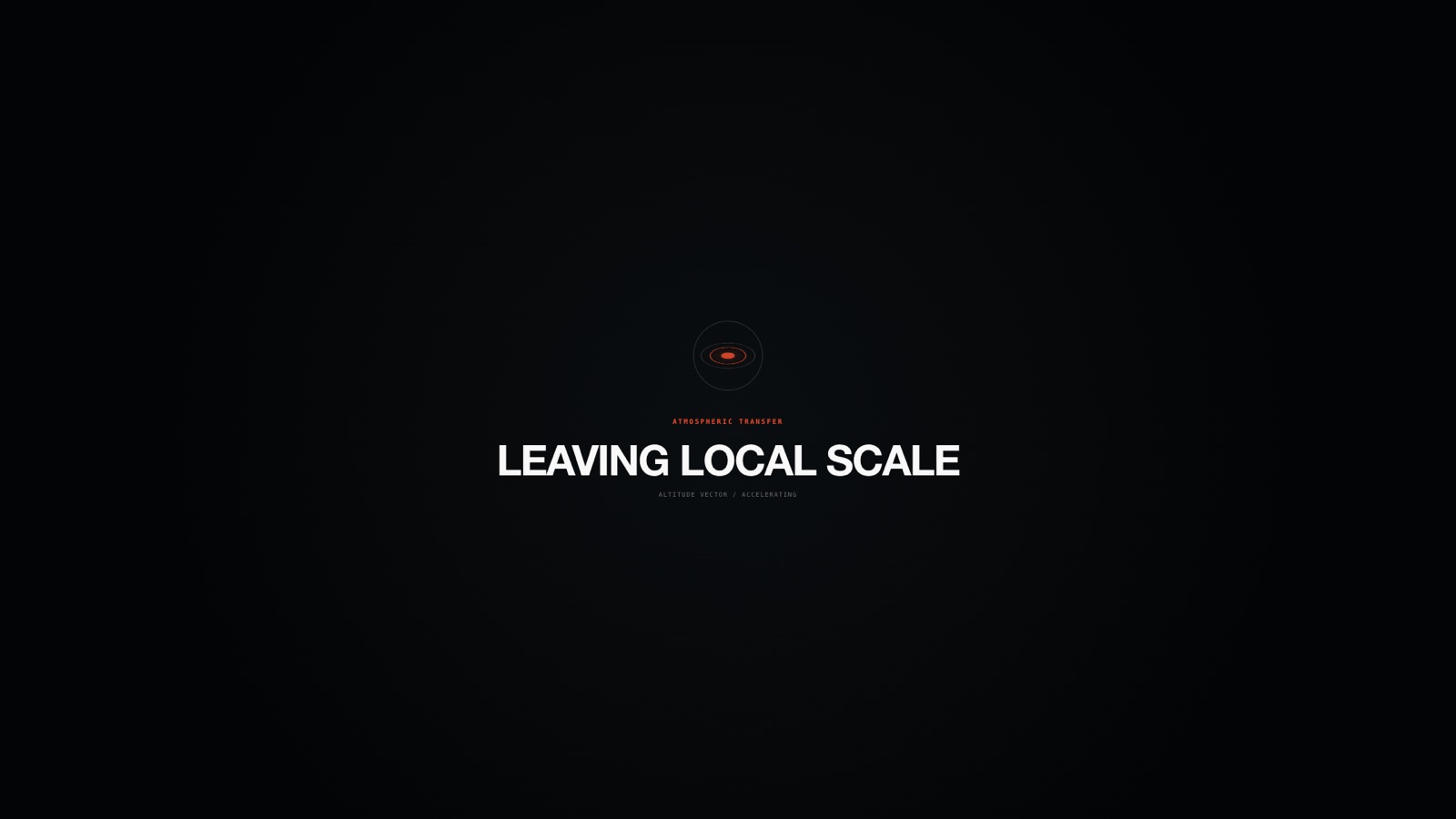
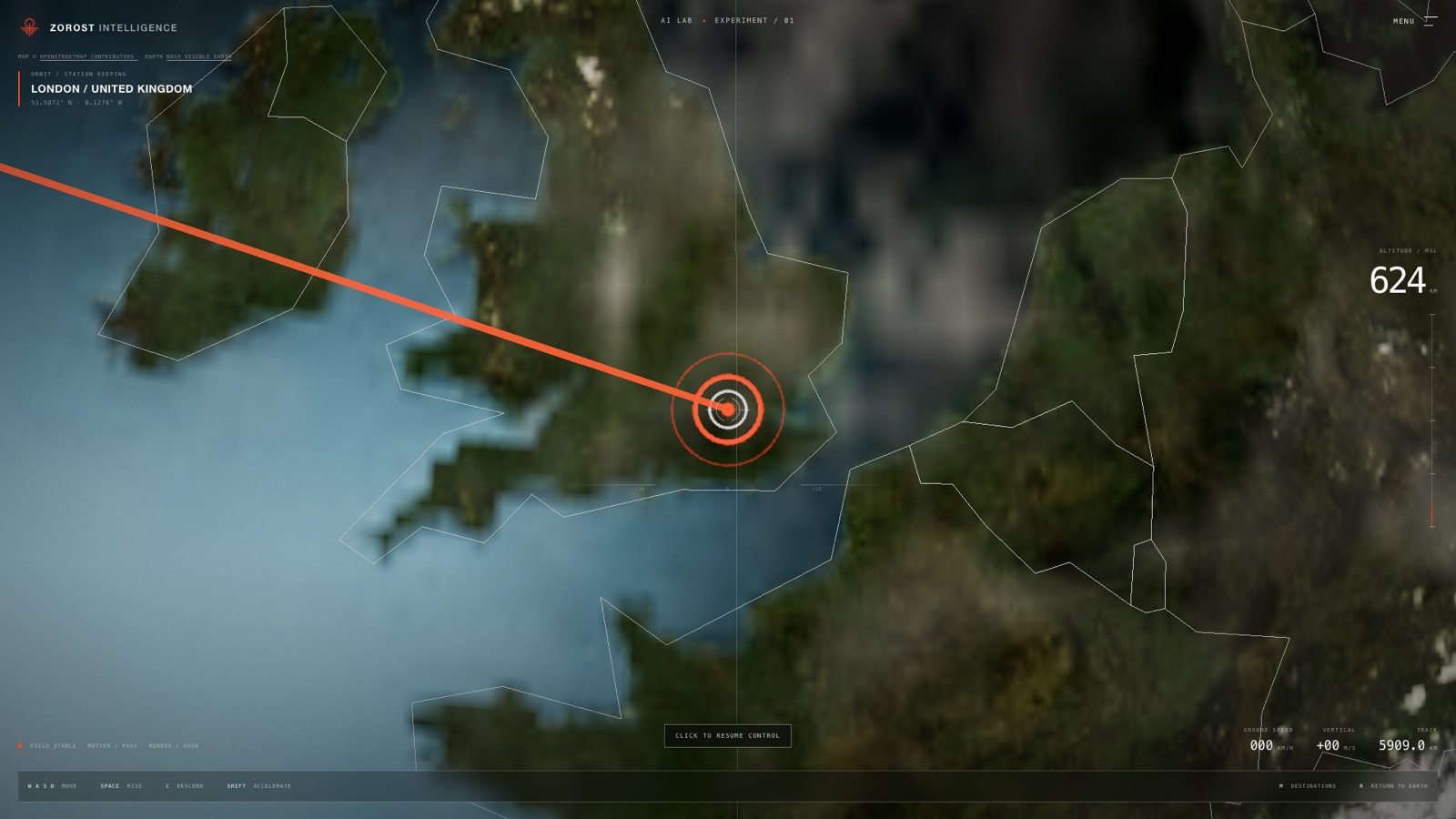
What Held, What We Flag
Wins and limits, side by side- The continuous local-to-orbital move shipped as designed, with no loading wall the viewer can feel.
- The model held one coherent architecture across the window: two scenes, one state machine, one movement model.
- Deferring the planet behind an explicit ascent kept the first load at 179 KiB gzip, well inside budget.
- Great-circle travel between real coordinates behaved correctly on re-test.
- Accessibility survived generation: reduced motion, keyboard, touch, and a non-WebGL fallback all work.
- The model does not do rights clearance. Judging which textures could be redistributed took human review, and two assets remain fetch-on-build for that reason.
- Deployment context defeats it quietly. Generated asset paths failed under a nested route and were caught by review, not by the model.
- Generated attribution does not survive a build chain on its own. The first provenance layer was stripped by the minifier, so provenance now travels in five layers.
- One model, one window. This is a dated field record of GPT 5.6 Sol under direction, not a ranking and not a general claim about model capability.
Measurements
Enforced on every build- Model under test
- GPT 5.6 Sol, supervised sessions
- Build window
- One overnight session, July 2026
- TypeScript produced
- About 3,500 lines, 18 modules
- Initial HTML, CSS, JS (gzip)
- 179 KiB against a 240 KiB budget
- Washington map (gzip)
- 1.06 MiB against a 1.3 MiB budget
- Material human corrections
- 4 logged in the window
The model wrote the code. The discipline made it ship.
Disclosures
What a careful reader deserves- Model output entered the build only after human engineering review. No unreviewed generated code ships in this experiment.
- Rendering and movement run entirely in the browser. The build collects no flight, location, or personal data.
- There is no avatar and no representation of any person.
- Geometry and imagery are grounded in public data and are not survey-grade or authoritative.
- The public source excludes assets whose redistribution terms are unconfirmed. A build script fetches them from their original sources for local use.
- Vendors and models are named as test subjects only. This is a dated field record, not an endorsement and not a product claim.
Go Deeper
Run it · read it · build on itServing those who
need to stay ahead.
We don't pitch slide decks. We show you what we've already built in your domain, then engineer what your mission requires.