
AeroFarr Is Live, Disruption Intelligence That Explains Itself
Pull-quote: “Every aviation tool can tell you a flight will be late. AeroFarr tells you why, what it will take down with it, and how confident you should be in both answers.”
The announcement
Today Zorost Intelligence is announcing that AeroFarr, our aviation disruption intelligence platform, is live: the first tier of the platform is in production, serving pre-departure delay, cancellation, and diversion risk through operations dashboards and a token-metered API.
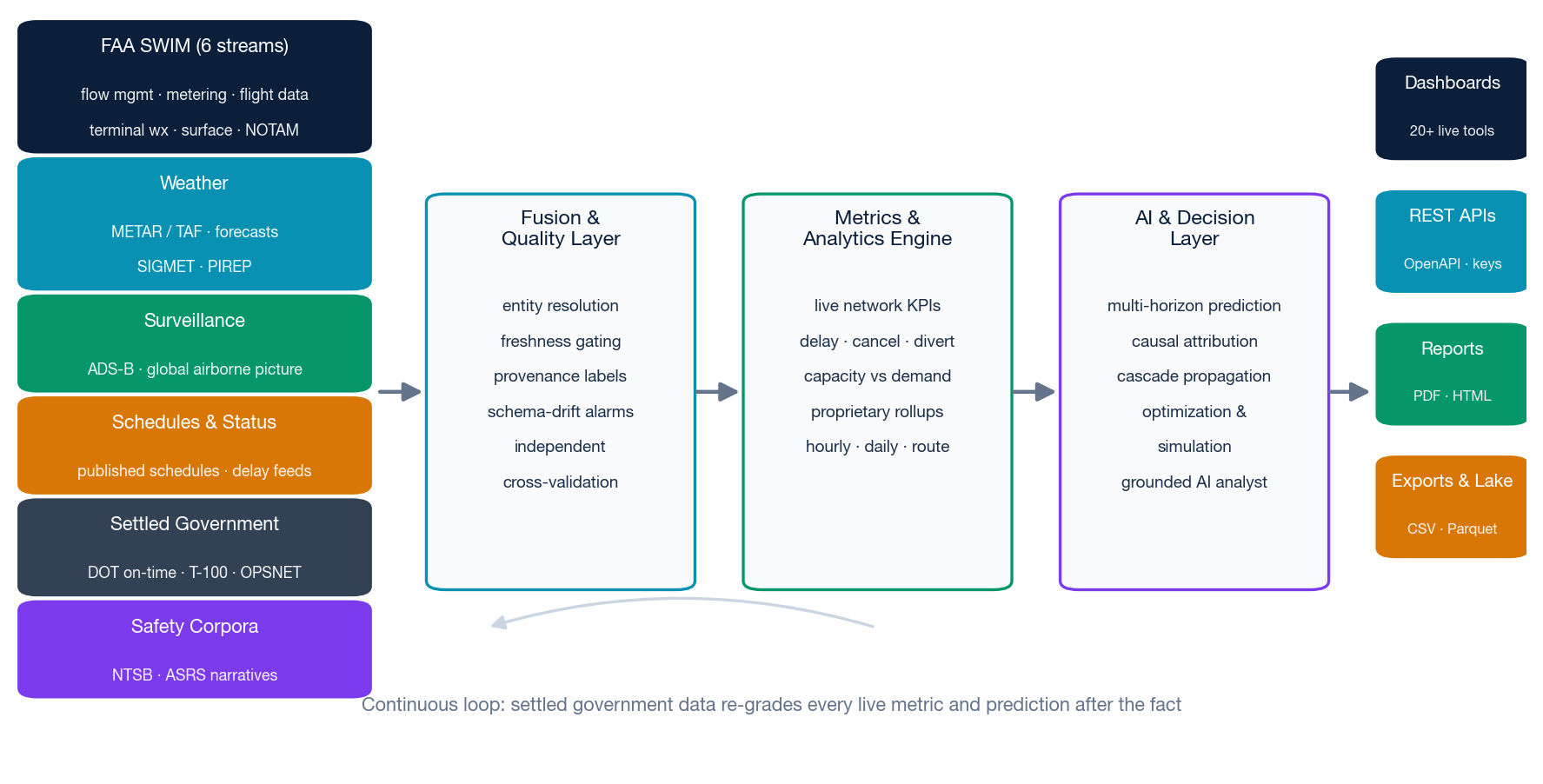
AeroFarr is not a flight tracker, and it is not another delay dashboard. It is a system built to reason about aviation operations the way a senior operations analyst does: it predicts disruption, explains the mechanism behind it, and traces how one disruption propagates through the network.
What is live today
Calibrated prediction across multiple horizons. AeroFarr scores delay, cancellation, and diversion risk from day-ahead down to minutes before departure. The platform is calibration-first: predictions ship with conformal prediction intervals and online recalibration, so an operator sees honest uncertainty instead of a bare point score. The models are trained on tens of millions of real U.S. flight records from public-domain sources.
Explanation on every prediction. Each risk score carries feature attribution and a causal narrative an operator can act on: not “weather correlates with delay” but which upstream mechanism is driving today’s risk for this specific flight.
Network cascade awareness. Delays do not stay where they start. AeroFarr models how a disruption at one airport propagates through aircraft rotations and network connections, so the question “which of my flights are exposed to this morning’s ground stop” has an answer.
Retrieval over the public safety corpus. AeroFarr indexes the NTSB accident database and NASA ASRS safety reports, close to two million documents, and answers operational safety questions with citations back to the underlying reports.
Dashboards and API. Operations teams work in the dashboards. Engineering teams integrate the same intelligence through a token-metered public API.
Why we built it this way
The aviation analytics market is served by data companies that collect and resell telemetry, and by consulting firms that answer causal questions manually over months. The gap between them is a platform that reasons: predicts with stated uncertainty, explains with stated mechanisms, and does both continuously. That is the gap AeroFarr fills, built almost entirely on public-domain aviation data, with the differentiation in the modeling rather than in proprietary feeds.
What comes next
The prediction tier is the foundation. The roadmap ahead of us extends the same discipline to counterfactual simulation and planning workloads. We will announce those tiers when they ship, not before.
AeroFarr is live at aerofarr.com. For a platform briefing or API access, reach us through zorost.com/contact.